Saved notebook output; this documentation build does not execute cells. Download the notebook.
Oklahoma severe-weather reports, May 2024
Storm Events support is available since v0.8. This notebook downloads one complete annual NCEI event-details archive (about 13 MB compressed for 2024), opens the gzip CSV locally, and selects Oklahoma reports beginning in May. We compare recorded tornado, hail, and thunderstorm-wind events and inspect the tornado damage ratings.
This is a description of archived reports, not a forecast, risk ranking, or count of distinct storms. An episode can have many events, and a tornado can cross counties and generate multiple event records. Archive revisions can change saved results. The separate locations and individual-fatality tables are outside this adapter's scope.
Run just notebooks from the repository root. The first run needs internet access. Keep the manifest, generated lockfile, and cached source bytes together for reproducibility.
import platform
from datetime import UTC, datetime
from pathlib import Path

import matplotlib
import matplotlib.pyplot as plt
import pandas as pd

import usdata
from usdata.cache import sha256_file
from usdata.pull import pull, verify

folder = Path.cwd()
if not (folder / "dataset.yaml").exists():
    folder = folder / "examples" / "storm-events"
manifest = folder / "dataset.yaml"
assert manifest.is_file(), "Run from the notebook folder or repository root"
print("Executed UTC:", datetime.now(UTC).isoformat())
print(
    "Versions:",
    {
        "Python": platform.python_version(),
        "usdata": usdata.__version__,
        "pandas": pd.__version__,
        "matplotlib": matplotlib.__version__,
    },
)
Executed UTC: 2026-09-09T00:31:23.262021+00:00
Versions: {'Python': '3.14.3', 'usdata': '0.7.0', 'pandas': '3.0.5', 'matplotlib': '3.11.1'}
Resolve and pin the source archive
The query touches May 2024, but the adapter selects all of the 2024 file, including all states and event types. Geographic and variable selectors are rejected; filtering belongs in the analysis. The newest supported creation-date filename is selected when resolving. Subsequent pull calls use the exact filename and checksum in the lockfile, without consulting the directory again. Historical files can be revised or removed upstream; a lockfile detects changed bytes but cannot guarantee old downloads remain available.
result = pull(manifest)
(item,) = result.fetched
print("Archive:", item.asset.id)
print("Compressed bytes:", item.provenance.size)
print("Nominal file year:", item.asset.time.start.year)
print("Source URL:", item.provenance.source_url)
print("Retrieved UTC:", item.provenance.retrieved_at.isoformat())
print("SHA-256:", item.provenance.checksum)
assert item.path.read_bytes()[:2] == b"\x1f\x8b"
source_checksum = sha256_file(item.path)
Archive: StormEvents_details-ftp_v1.0_d2024_c20260728.csv.gz
Compressed bytes: 12693243
Nominal file year: 2024
Source URL: https://www.ncei.noaa.gov/pub/data/swdi/stormevents/csvfiles/StormEvents_details-ftp_v1.0_d2024_c20260728.csv.gz
Retrieved UTC: 2026-09-09T00:31:36.336422+00:00
SHA-256: sha256:2070b83eccab041b36360ab73645b9a249c3eefc5b92b5b3fc0cbba4d9fcc09c
Open locally and filter by reported civil date
open() decompresses in memory through a local stream; the cached file and its checksum remain compressed and unchanged. Identifier columns retain their source strings. We construct the begin calendar date from numeric year/month/day fields, avoiding ambiguous two-digit dates. These are reported local dates; this notebook makes no conversion to UTC. CZ_TIMEZONE needs separate attention when comparing precise event instants across regions.
columns = [
    "BEGIN_YEARMONTH",
    "BEGIN_DAY",
    "EVENT_ID",
    "EPISODE_ID",
    "STATE",
    "STATE_FIPS",
    "CZ_TYPE",
    "CZ_FIPS",
    "EVENT_TYPE",
    "CZ_TIMEZONE",
    "TOR_F_SCALE",
]
frame = item.open(usecols=columns)
yearmonth = pd.to_numeric(frame["BEGIN_YEARMONTH"], errors="coerce")
begin_date = pd.to_datetime(
    {"year": yearmonth // 100, "month": yearmonth % 100, "day": frame["BEGIN_DAY"]}, errors="coerce"
)
types = ["Tornado", "Hail", "Thunderstorm Wind"]
selected = frame.loc[
    frame["STATE"].eq("OKLAHOMA")
    & begin_date.ge("2024-05-01")
    & begin_date.lt("2024-06-01")
    & frame["EVENT_TYPE"].isin(types)
].copy()
selected["BEGIN_DATE"] = begin_date.loc[selected.index]
print("Rows in annual details archive:", len(frame))
print("Rows with unparseable begin date:", int(begin_date.isna().sum()))
print("Selected records:", len(selected), "distinct EVENT_ID:", selected["EVENT_ID"].nunique())
print("Recorded time-zone labels:", sorted(selected["CZ_TIMEZONE"].dropna().unique()))
print(
    "Identifier dtypes:",
    {name: str(frame[name].dtype) for name in ["EVENT_ID", "EPISODE_ID", "STATE_FIPS", "CZ_FIPS"]},
)
assert not selected.empty
assert frame.attrs["usdata"]["provenance"]["checksum"] == source_checksum
selected[["EVENT_ID", "BEGIN_DATE", "EVENT_TYPE", "CZ_TYPE", "CZ_FIPS", "TOR_F_SCALE"]].head(8)
Rows in annual details archive: 69801
Rows with unparseable begin date: 0
Selected records: 589 distinct EVENT_ID: 589
Recorded time-zone labels: ['CST-6']
Identifier dtypes: {'EVENT_ID': 'string', 'EPISODE_ID': 'string', 'STATE_FIPS': 'string', 'CZ_FIPS': 'string'}
| EVENT_ID | BEGIN_DATE | EVENT_TYPE | CZ_TYPE | CZ_FIPS | TOR_F_SCALE | |
|---|---|---|---|---|---|---|
| 256 | 1178562 | 2024-05-06 | Hail | C | 81 | NaN |
| 15716 | 1222698 | 2024-05-06 | Thunderstorm Wind | C | 73 | NaN |
| 16029 | 1222697 | 2024-05-06 | Thunderstorm Wind | C | 103 | NaN |
| 16743 | 1222699 | 2024-05-06 | Thunderstorm Wind | C | 73 | NaN |
| 16744 | 1222700 | 2024-05-19 | Thunderstorm Wind | C | 39 | NaN |
| 17577 | 1222696 | 2024-05-06 | Thunderstorm Wind | C | 47 | NaN |
| 17649 | 1222701 | 2024-05-25 | Thunderstorm Wind | C | 47 | NaN |
| 17752 | 1183460 | 2024-05-25 | Thunderstorm Wind | C | 131 | NaN |
Compare recorded events and tornado ratings
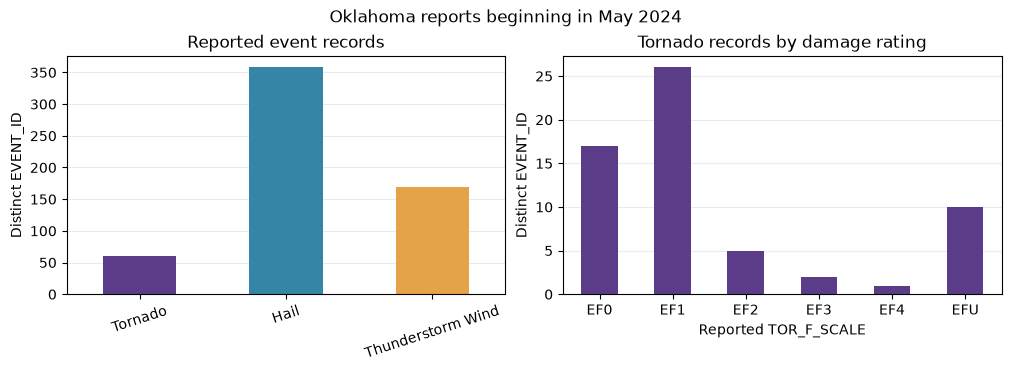
Counts below are distinct EVENT_ID values, not distinct episodes or physical tornadoes. CZ_TYPE distinguishes counties from forecast zones and marine areas; CZ_FIPS alone is not universally a county FIPS code. The second chart keeps missing ratings visible. EFU is the source code for an unknown Enhanced Fujita rating, retained as its own category (NWS explanation). Enhanced Fujita ratings describe damage-based estimates; they are neither direct wind measurements nor comparable to hail diameters or wind gusts. This single-month analysis avoids treating changes in reporting and historical event coverage as climate trends.
counts = selected.groupby("EVENT_TYPE")["EVENT_ID"].nunique().reindex(types, fill_value=0)
tornadoes = selected.loc[selected["EVENT_TYPE"].eq("Tornado")].copy()
tornadoes["RATING"] = tornadoes["TOR_F_SCALE"].fillna("Unknown")
ratings = tornadoes.groupby("RATING")["EVENT_ID"].nunique().sort_index()
print("Distinct event records by type:")
print(counts.to_string())
print("\nTornado records by reported rating:")
print(ratings.to_string())

fig, axes = plt.subplots(1, 2, figsize=(10, 3.6), layout="constrained")
counts.plot.bar(ax=axes[0], color=["#5b3c88", "#3586a6", "#e4a348"], rot=18)
axes[0].set(title="Reported event records", xlabel="", ylabel="Distinct EVENT_ID")
if not ratings.empty:
    ratings.plot.bar(ax=axes[1], color="#5b3c88", rot=0)
axes[1].set(
    title="Tornado records by damage rating",
    xlabel="Reported TOR_F_SCALE",
    ylabel="Distinct EVENT_ID",
)
for axis in axes:
    axis.grid(axis="y", alpha=0.25)
    axis.set_axisbelow(True)
fig.suptitle("Oklahoma reports beginning in May 2024")
plt.show()
Distinct event records by type:
EVENT_TYPE
Tornado               61
Hail                 358
Thunderstorm Wind    170

Tornado records by reported rating:
RATING
EF0    17
EF1    26
EF2     5
EF3     2
EF4     1
EFU    10
Check source integrity and cache reuse
Analysis has not altered the archive. A repeated pull validates cached bytes against the pinned revision. If validation fails, preserve the original lockfile and investigate the revision; pull(..., force=True) deliberately resolves current filenames and writes a new lockfile.
assert sha256_file(item.path) == source_checksum
assert verify(manifest) == []
again = pull(manifest)
assert again.from_lockfile and all(value.from_cache for value in again.fetched)
print("Verification passed; locked archive reused from cache.")
print("Analysis source checksum:", source_checksum)
Verification passed; locked archive reused from cache.
Analysis source checksum: sha256:2070b83eccab041b36360ab73645b9a249c3eefc5b92b5b3fc0cbba4d9fcc09c
Source notes and limitations
- NCEI bulk archive README explains annual filenames and creation-date revisions.
- NCEI bulk field definitions define event/episode identifiers, county and zone codes, time-zone fields, and tornado segments. Use the source definitions before aggregating impacts or combining tables.
- NCEI dataset metadata describes the archive and its varying historical coverage. The records are reports, not a uniform observation network; missing reports do not establish that no event occurred.
- NWS Enhanced Fujita scale explains damage-based ratings and the 2007 transition from the original Fujita scale. Ratings should not be averaged as measured wind speeds.
This notebook intentionally does not sum dollar damage: source values contain magnitude suffixes, can be missing or estimated, and require explicit parsing and economic assumptions. It also does not infer a climate trend from one month. Saved outputs describe the exact revision identified above.